



GoDaddy's Ultimate Linux Hosting with cPanel is the top Web Hosting plan: 25 websites, 75 GB of NVMe storage, unmetered bandwidth and a free domain, for $12.99 a month on a 3-year term (GoDaddy's US Web Hosting page). GoDaddy pitches it for multi-site, high-traffic sites.
My verdict is no for that use. All 25 sites share 2 CPU cores, 1.5 GB of memory and 250,000 files, the plan keeps one day of backups, and GoDaddy sites slow down sharply under load. A few small sites run fine on it; a busy portfolio of sites doesn't.
Prices, plans, support chats and test results on this page were checked in November 2026.
I'm a web developer, and many of my clients host their sites at GoDaddy. This review uses what I see in the GoDaddy client accounts I manage, GoDaddy's own published limits and my load tests of GoDaddy customer sites.
Contents
- What Is GoDaddy Ultimate Linux Hosting with cPanel?
- Features of Ultimate Linux Hosting with cPanel
- Pros of the GoDaddy Ultimate Plan
- Cons of the GoDaddy Ultimate Plan
- How Much Does GoDaddy's Ultimate Plan Cost?
- GoDaddy Ultimate vs Hostinger Unlimited
- Who Is GoDaddy's Ultimate Plan For?
- Should You Choose GoDaddy's Ultimate Plan?
- Better Alternative to GoDaddy: Hostinger
What Is GoDaddy Ultimate Linux Hosting with cPanel?
Ultimate is the largest of GoDaddy's three Web Hosting plans, above Economy and Deluxe. GoDaddy groups Deluxe and Ultimate as "High Performance", "great for multi-site, high traffic or resource-heavy sites and apps".
It's still shared hosting. GoDaddy's own FAQ says Web Hosting plans "provide shared processing and memory resources across all tenants", and points sites that need guaranteed resources to its Web Hosting Plus plans.
Features of Ultimate Linux Hosting with cPanel
According to GoDaddy's plan card and its resource limits help page, Ultimate includes:
| Feature | Ultimate |
|---|---|
| Websites | 25 |
| Storage | 75 GB NVMe |
| CPU | 2 accessible cores (shared server) |
| Memory | 1.5 GB |
| Entry processes | 40 |
| Processes (NProcs) | 55 |
| Disk I/O | 10,240 KB/s |
| Files (inodes) | 250,000 |
| Bandwidth | Unmetered |
| Backups | Automatic daily, restores from the previous day |
| Extras on the plan card | Node.js, free domain, "Free email", free SSL, 30-day money-back guarantee |
The plan card names the panel "GoDaddy Control Panel". The client accounts I manage run cPanel 134 (Jupiter theme), where you get the usual tools: File Manager, MySQL databases, Git Version Control, cron jobs and an app installer for WordPress and other CMSs.
Real accounts don't always match the help page. The cPanel of a client's Deluxe account I manage shows 512 MB of memory and 100 entry processes, while the help page lists 1 GB and 30 for Deluxe. Check Resource Usage in your own cPanel for the limits that actually apply to you.
Pros of the GoDaddy Ultimate Plan
- Room for 25 websites under one subscription, the most of any GoDaddy Web Hosting plan.
- Twice the CPU of Deluxe on paper: 2 accessible cores and 1.5 GB of memory, compared with 1 core and 1 GB on Deluxe (GoDaddy's help page).
- 75 GB of NVMe storage, plenty for a set of small business sites.
- Node.js included, run from GoDaddy's hosting dashboard (North America or Europe regions only), which many cPanel shared plans don't offer.
- Free domain for the first year with the plan.
- Familiar cPanel in the accounts I manage, with Git Version Control and cron jobs.
Cons of the GoDaddy Ultimate Plan
Slows down sharply under load
At normal traffic, GoDaddy lands among average hosts. I tested 2 customer sites on GoDaddy shared hosting with k6 from Ashburn, USA: one with its server in the USA and one in Singapore (exact plans unknown). Their server time, the uncached response with the network round trip removed, averaged 666 ms: 443 ms on the US site and 889 ms on the Singapore site.
That's 11th of 23 shared hosts (grade C) on my web hosting benchmarks page. Measured from Ashburn, the uncached response averaged 814 ms (502 ms and 1,126 ms), because the round trip to Singapore adds about 237 ms.
Under load, it's a different picture. I load-tested the US site: its uncached response climbed from 576 ms to 3.5 s as visitors grew to about 25 at once, and at about 30 visitors k6 stopped the test with 41% of requests failing. I haven't load-tested the Singapore site, so this is one site, not every GoDaddy server.
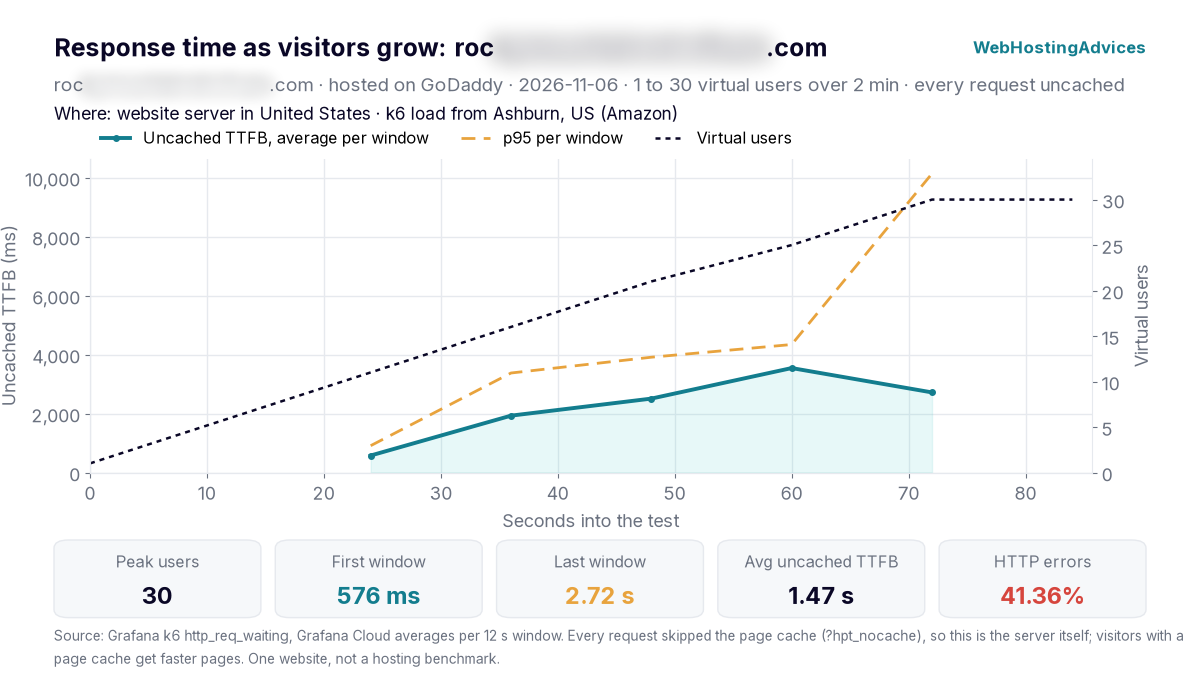
k6 ramp test on November 6, 2026, at about 3 am US Eastern: visitors rose from 1 toward 50 over 2 minutes, every request uncached. The response went from 576 ms at about 11 visitors to 3.5 s at about 25; at about 30 visitors k6 stopped the test with 41% of requests failing (server errors). Website server in the USA, load sent from Ashburn, USA. One website, not a hosting benchmark.
That matters most on a plan sold for high-traffic and multi-site use: every site on the account shares the same 2 cores and 1.5 GB.
The 250,000-file limit caps the "25 websites"
GoDaddy's help page lists 250,000 files (inodes) for every Web Hosting plan, from Economy to Ultimate. Ultimate allows 25 times more websites than Economy, but not one more file.
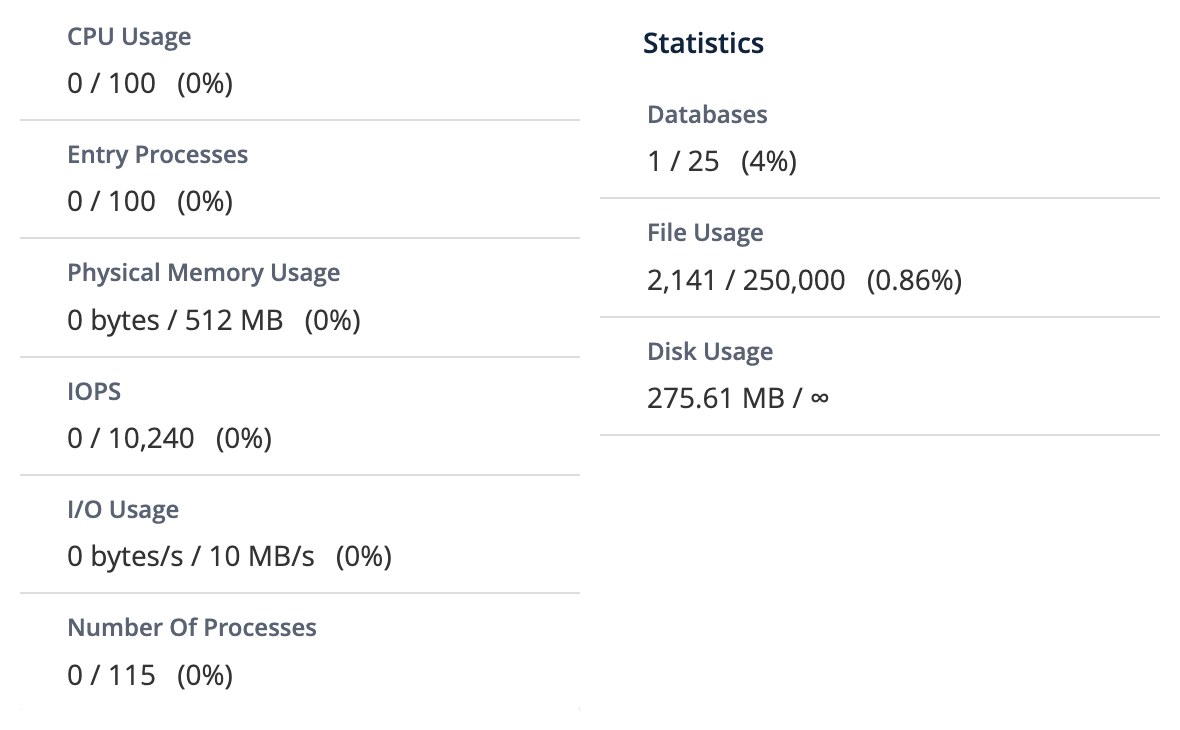
The resource limits in the cPanel of a client's Deluxe account I manage, with the same 250,000-file cap (November 20, 2026).
You can read more about how this works in my guide to inode limits.
One day of backups and monthly malware scans
The client accounts I manage keep one automated daily backup, and "up to 30 days of backups" is a paid upgrade. GoDaddy's own plan page says the daily backup restores your account "from the previous day".
With 25 sites on one account, that's thin protection: a problem noticed after two days is already in the only backup. Malware protection is basic too, with a monthly scan and cleanup on the Basic plan and real-time cleanup as a paid upgrade.
Paid extras: email, old PHP and resources
The plan card lists "Free email", but the hosting dashboard of a client's Deluxe account shows 0 mailboxes included. An account still on PHP 7.4 is charged $4.99 for Extended Support from its next renewal, and a GoDaddy live chat agent told me that it's a yearly fee. Switching to PHP 8.2 or newer is free and takes a click, but test the site first, because old plugins can break on PHP 8.
Extra CPU, memory and entry processes are sold as resources on demand. And on SSL, check your own cPanel: one client account I manage showed an expired, self-signed certificate warning. A GoDaddy live chat agent told me that the free SSL on Deluxe is "included in the Hosting plan for one year", so expect to pay for SSL after the first year on Ultimate too unless GoDaddy confirms otherwise.
Slow live chat support
The top shared plan doesn't get faster support. Every GoDaddy chat starts with its AI assistant, and a person comes later: in my chats on November 20, 2026, GoDaddy estimated 15 to 48 minutes in the queue, and a person joined after about 20 minutes. While you wait, there's no countdown. When the chat said a guide was "almost ready", my question about how long was left was marked as read but got no answer for 8 minutes.

My question about the remaining wait was marked as read but got no reply (GoDaddy live chat, November 20, 2026).
For a busy site on Ultimate, that wait matters more than the price. The full chat is in why GoDaddy sucks (#8).
Resource-heavy plugins hit the limits first
Security and backup plugins that scan every file, like Wordfence, can use a lot of CPU and memory on shared hosting. On a plan where all sites share 1.5 GB, schedule those scans for quiet hours and watch Resource Usage in cPanel. I explain what happens when you hit the ceiling in my post on GoDaddy CPU limits.
How Much Does GoDaddy's Ultimate Plan Cost?
Ultimate costs $12.99 a month for the first 3-year term, compared with a regular price of $21.99 a month shown on the same card (GoDaddy's US Web Hosting page). A GoDaddy live chat agent told me that Ultimate on a 1-year term costs $179.88 and renews at $263.88 a year ($21.99 a month). The agent didn't give me the renewal price after a 3-year term, so check that in the cart before you pay. The agent also said renewal discounts of up to 15 to 20 percent are available on yearly plans if you ask.
The free domain covers the first year only. After that, the .com domains of clients I manage at GoDaddy renew at $22.99 a year. Add mailboxes, a 30-day backup history or extra resources, and the yearly total climbs fast. My post on GoDaddy's renewal prices covers the domain side.
GoDaddy Ultimate vs Hostinger Unlimited
Hostinger's Unlimited plan is the closest match for someone who needs many sites. Here's how they compare on figures from each host's own pages:
| GoDaddy Ultimate | Hostinger Unlimited | |
|---|---|---|
| Websites | 25 | Unlimited |
| Storage | 75 GB NVMe | 50 GB NVMe |
| Backups | Daily, 1 day kept (30 days paid) | Daily backups |
| "Free email" on the card, 0 mailboxes in the dashboard | Unlimited mailboxes per website, free for 1 year | |
| SSL | Free SSL listed on the plan card | Free SSL certificate |
GoDaddy: US Web Hosting page (November 18, 2026) and client accounts I manage (November 20, 2026). Hostinger: hostinger.com/web-hosting (checked November 20, 2026).
GoDaddy gives you more storage. Hostinger includes more of the basics that GoDaddy charges for, like a longer backup history and mailboxes. Hostinger's prices change often around Black Friday, so check the current Unlimited price on its site.
Who Is GoDaddy's Ultimate Plan For?
Ultimate fits someone who wants several small, low-traffic sites in one GoDaddy account, already keeps their domains at GoDaddy, and has a separate backup routine.
It's a poor fit for what GoDaddy markets it for: many sites with real traffic. The shared 1.5 GB of memory, the 250,000-file cap and the slowdown under load all hit before you reach 25 busy websites.
Should You Choose GoDaddy's Ultimate Plan?
No, not for a growing portfolio of sites. Ultimate gives you more website slots and storage than Deluxe, but the same one day of backups, the same 250,000 files, and a host that struggles under load.
If you already have it, check your inode usage, Resource Usage and renewal price in your account. If any of them is close to the limit, plan a move before the next renewal.
Better Alternative to GoDaddy: Hostinger
If you pay for GoDaddy's Ultimate plan mainly to host many sites, I recommend Hostinger. Its plans start with Premium at $2.49 a month on a 48-month term, renewing at $10.99 a month (checked October 22, 2026), and the Unlimited plan removes the website cap. Hostinger's team moves your sites from GoDaddy with its free migrations.
To be fair about speed: at light load, Hostinger and GoDaddy were close in my tests (server time 633 ms vs. 666 ms, from Ashburn, USA). Pick Hostinger for the lower total cost and the included backups and email, not for raw speed.