

Vultr is a Cloud hosting provider where you can easily deploy your project. It provides bare metal, storage, and deployment. This article is not about the hosting itself but it’s about Vultr server locations.
When you are using a cloud infrastructure, the server location is the most important thing that you need to keep in mind. Unlike shared hosting, here you can’t take the location for granted. So, here is a guide on Vultr data centers.
As always, I will cover more than just Vultr’s server locations, so stay until the end. You will know a lot more about Vultr by then.
Contents
Vultr Server Locations
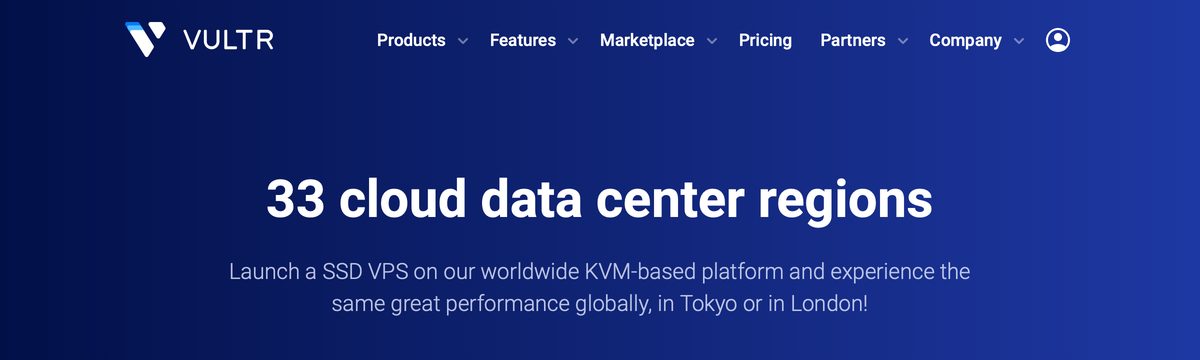
Instead of starting with an overview, let’s get straight to the point.
Vultr provides a global cloud for you. They have many data centers you can choose from.
There are a total of 34 Vultr data center regions in 20 countries, according to Vultr's data center page (checked November 2026). When you are creating your account on Vultr, you can easily choose the server location and set the server which suits you the most.
The 34 locations are as follows.
| Location | Country | Region |
|---|---|---|
| Atlanta | United States | North America |
| Chicago | United States | North America |
| Dallas | United States | North America |
| Honolulu | United States | North America |
| Los Angeles | United States | North America |
| Miami | United States | North America |
| New Jersey (New York Area) | United States | North America |
| Seattle | United States | North America |
| Silicon Valley (San Francisco Bay Area) | United States | North America |
| Mexico City | Mexico | North America |
| Toronto | Canada | North America |
| Santiago | Chile | South America |
| São Paulo | Brazil | South America |
| Amsterdam | Netherlands | Europe |
| Frankfurt | Germany | Europe |
| London | United Kingdom | Europe |
| Madrid | Spain | Europe |
| Manchester | United Kingdom | Europe |
| Milan | Italy | Europe |
| Paris | France | Europe |
| Stockholm | Sweden | Europe |
| Warsaw | Poland | Europe |
| Bangalore | India | Asia |
| Delhi NCR | India | Asia |
| Mumbai | India | Asia |
| Chennai | India | Asia |
| Osaka | Japan | Asia |
| Seoul | South Korea | Asia |
| Singapore | Singapore | Asia |
| Tel Aviv | Israel | Asia |
| Tokyo | Japan | Asia |
| Melbourne | Australia | Australia |
| Sydney | Australia | Australia |
| Johannesburg | South Africa | Africa |
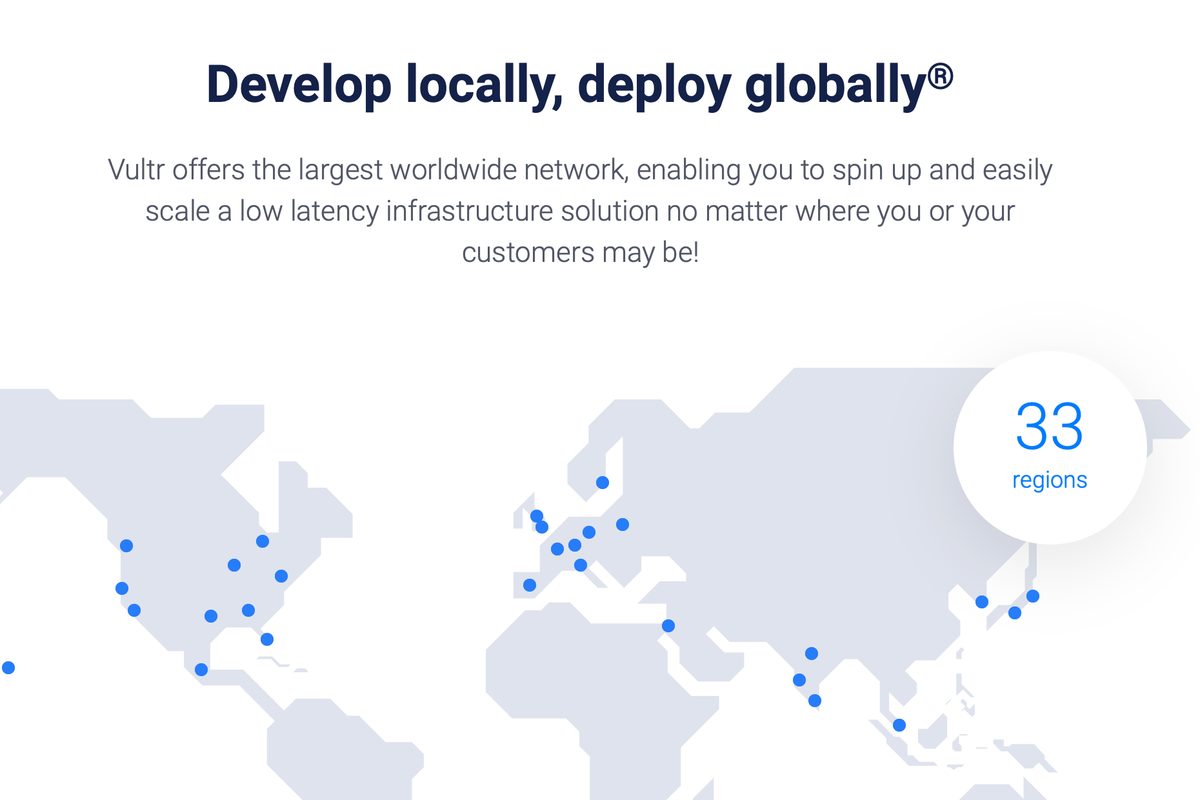
If the table above is hard to scan, let’s quickly categorize the location before we move further. We will also see a bit further detail here.
I have divided them by continent. So, your work will be a lot easier.
Unlike above, here we will also see the name of the city and country where the data center is located. In this way, you can know the exact location and select the one that suits you the most.
North America
- Toronto, Canada
- Mexico City, Mexico
- New Jersey (New York Area), United States
- Chicago, United States
- Miami, United States
- Silicon Valley (San Francisco Bay Area), United States
- Atlanta, Georgia, United States
- Los Angeles, United States
- Seattle, United States
- Dallas, United States
- Honolulu, Hawaii, United States
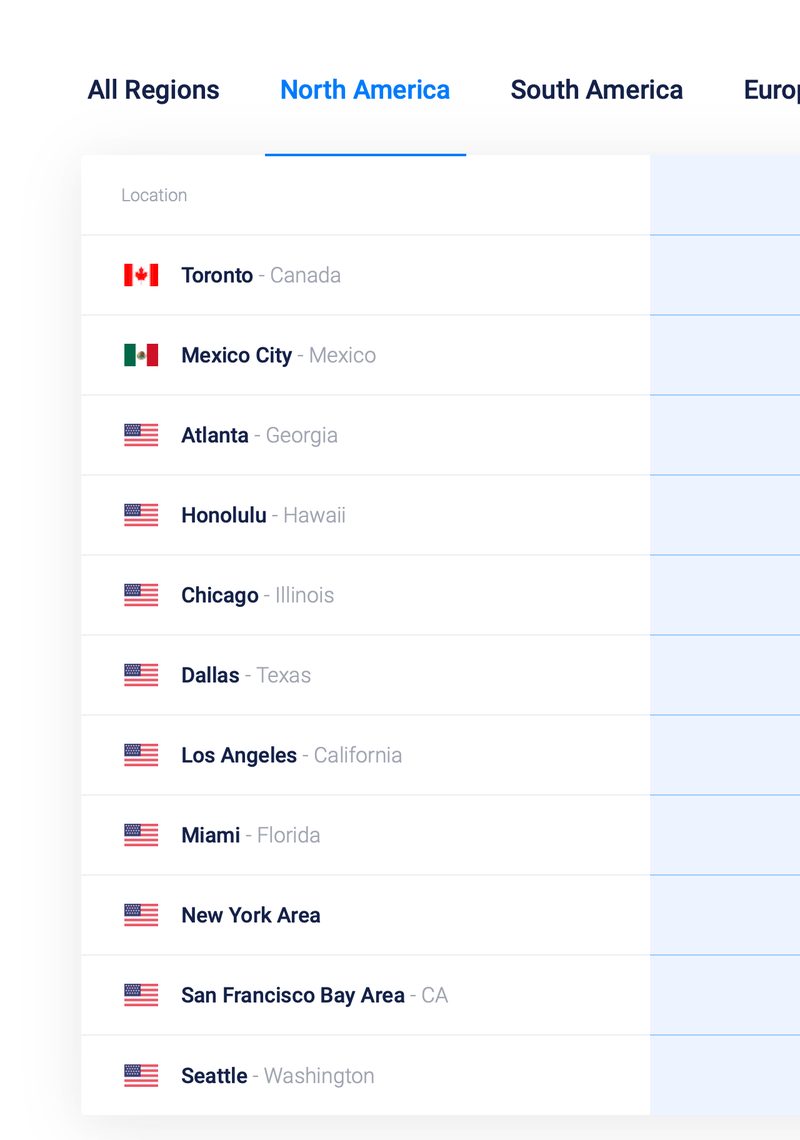
The good thing here is that they also have a data center in Silicon Valley. So, even if you are providing services to the tech giants, you can surely use the service.
They also have servers in many US states, which gives you plenty of choice.
You can choose the nearest location where you provide your service. A closer location also means lower latency for your visitors.
Europe
- Amsterdam, Netherlands
- London, United Kingdom
- Manchester, United Kingdom
- Paris, France
- Frankfurt, Germany
- Madrid, Spain
- Milan, Italy
- Stockholm, Sweden
- Warsaw, Poland
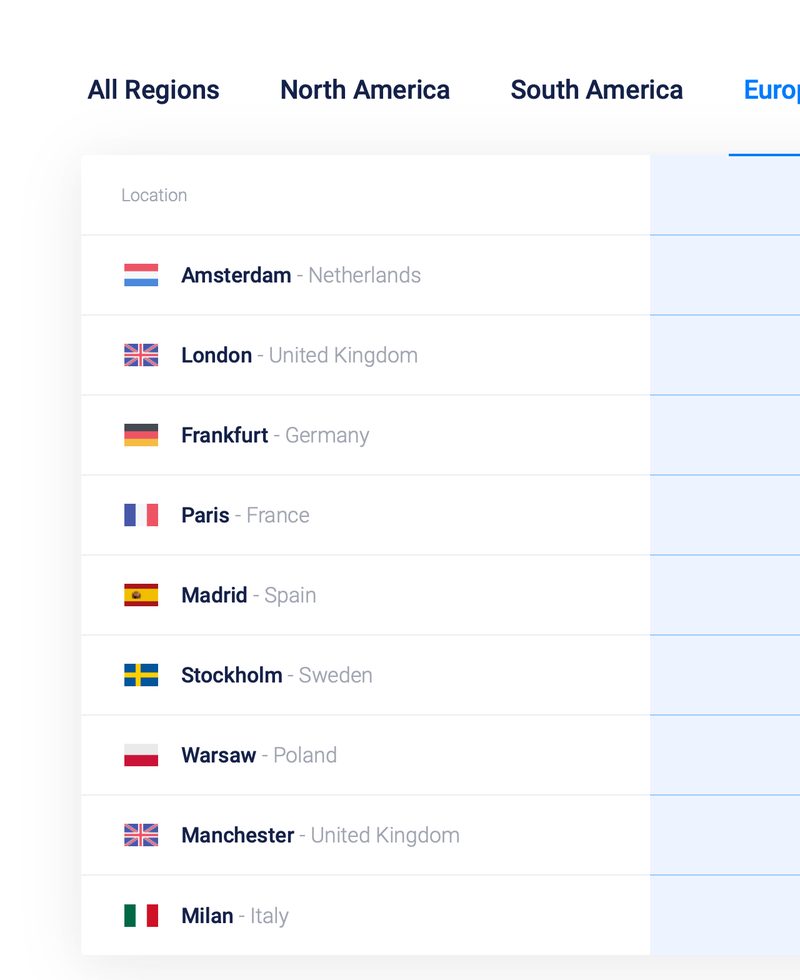
With the EU laws, it’s necessary to have the server in Europe for some companies. In this case, you can get the server that is located in Europe. Vultr has several European locations, so this is easy to arrange.
Asia
- Tokyo, Japan
- Osaka, Japan
- Seoul, South Korea
- Singapore, Singapore
- Mumbai, India
- Delhi NCR, India
- Bangalore, India
- Chennai, India
- Tel Aviv, Israel
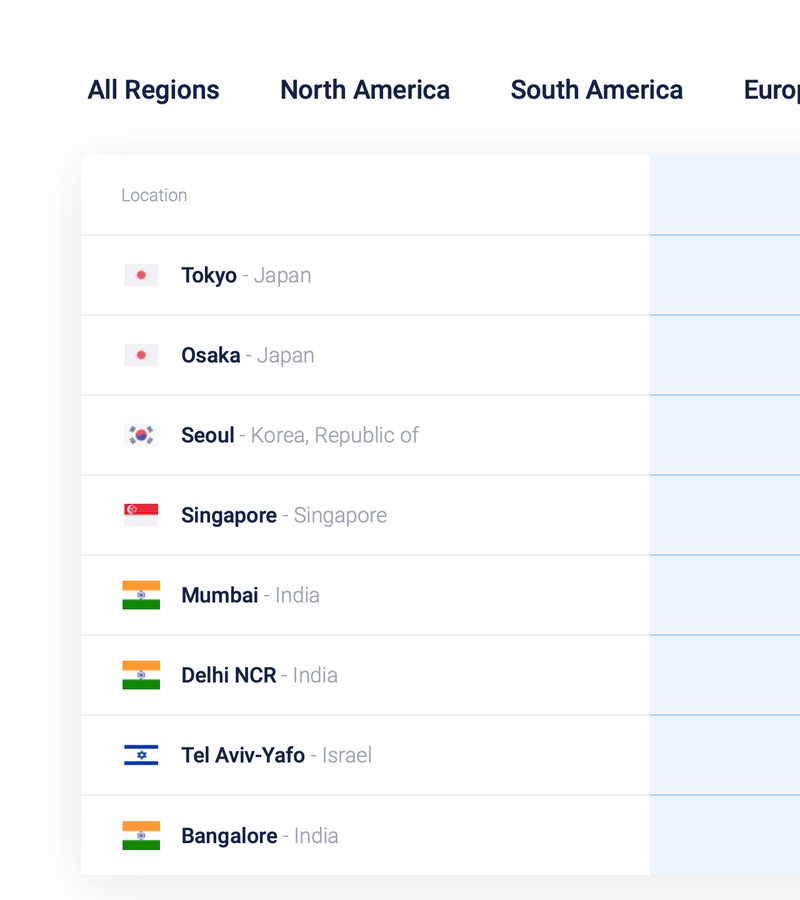
Most companies only have Singapore as their Asia data center. That’s not the case with Vultr. Vultr’s server locations also include 8 other places in Asia, four of them in India.
Australia
- Sydney, Australia
- Melbourne, Australia
South America
- São Paulo, Brazil
- Santiago, Chile
Africa
- Johannesburg, South Africa
How to Change Vultr data centers?
At first, when you are creating an account at Vultr, you will have to select a server location. Once you select a server location, your server will be set up there.
If you are a new user, you will have to follow 3 easy steps to select the server location.
You will have to create a new instance first. Head over to the “ deploy new instance ” option and follow the steps.
- Select the server you want in the Vultr
- Select the server location
- Select the type of server (OS and similar things)
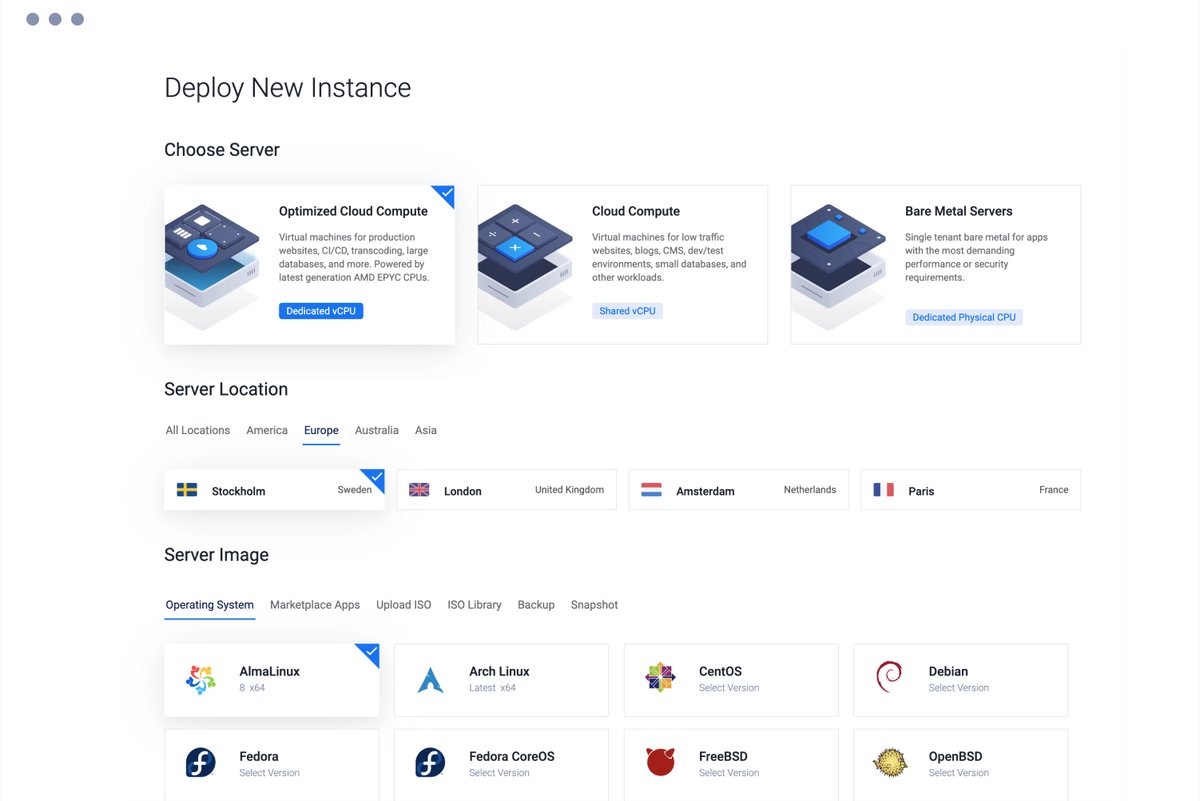
That’s it. You can easily do the same thing from your mobile phone too.
You don’t even need a desktop for this. (The main reason why we have seen these steps is that you will need them soon when we are changing the server location.)
What if you made a mistake here and want to change the server location? In this case, you might want to change the location.
First of all, is it possible to change the server location in Vultr?
Of course, yes. You can change it.
If you want to change the server location, you will have to take some time out of your busy schedule, grab a cup of coffee, and follow the steps we mention.
PS: You can also have a smoothie instead of coffee.
Steps to change the server location
Here are the steps to follow.
- Create a backup of your current server data. In technical language, you can create a quick snapshot of current data. (there will be an option for this)
- Now, you will have to create a new instance of the server in your preferred location.
- By now you get the idea: just restore the saved data here.
- You can easily install the data in the new location too.
- While it’s being restored, don’t forget to have a sip of your coffee.
- Wait, the work isn’t over yet. Once the data is restored, you will have to change the DNS of all the domains and IP addresses.
- You can just change one at first and see if the website is working properly or not.
- If everything is as expected, you can change the DNS of all the domains.
- Thereafter, you can test all the websites. Once everything is working smoothly, you can go ahead and delete the old instance. If space is not an issue, you can keep it for a while to confirm everything is fine.
- That’s pretty much it.
Now, you have successfully changed the server location of your website. It’s easy, right?
So, what’s the big deal? For most people, the problem will be to select the server location.
If you are the one who is confused about which server location is best for you, then you can continue reading this article. We will now see which Vultr locations are best as per your requirements.
How to select the server location?
If you ask me for the easiest way to select a server location, my answer is this. You need to select the location that is nearest to your customers. It doesn’t matter where you live, you will have to focus on your customers and visitors.
Even if you live in Singapore but you are doing business in the US, you will have to select the US server location. This is the easiest way to select a server location.
However, this holds true when you are using hosting. Vultr is a cloud and not a traditional hosting service. So, there is one more step to take here.
Remember, whenever you are selecting the server location on your Cloud, you will have to check the speed first. Only then, you can select the server location.
Of course, if you have worked with the Cloud infrastructure before, you would probably know about it. However, I recommend you take a quick look at the next section for the details. The next section will give you the exact answer on which server location you should select out of 34.
Testing Speed to Select the Server
The only way to be sure about the server location is to try it yourself. Vultr doesn’t give you a demo website for this. Instead, you check the download speed of each location with test files.
When we head over to the FAQ section on the official website of Vultr, you can easily find the server speed.
Instead of written details for each server, you will find two test files per server: one of 100 MB and one of 1 GB.
You can download those files to know the server speed of that particular server. You can change the version of the IP (IPv4 or IPv6) if you want. There is a small toggle switch to change the version.
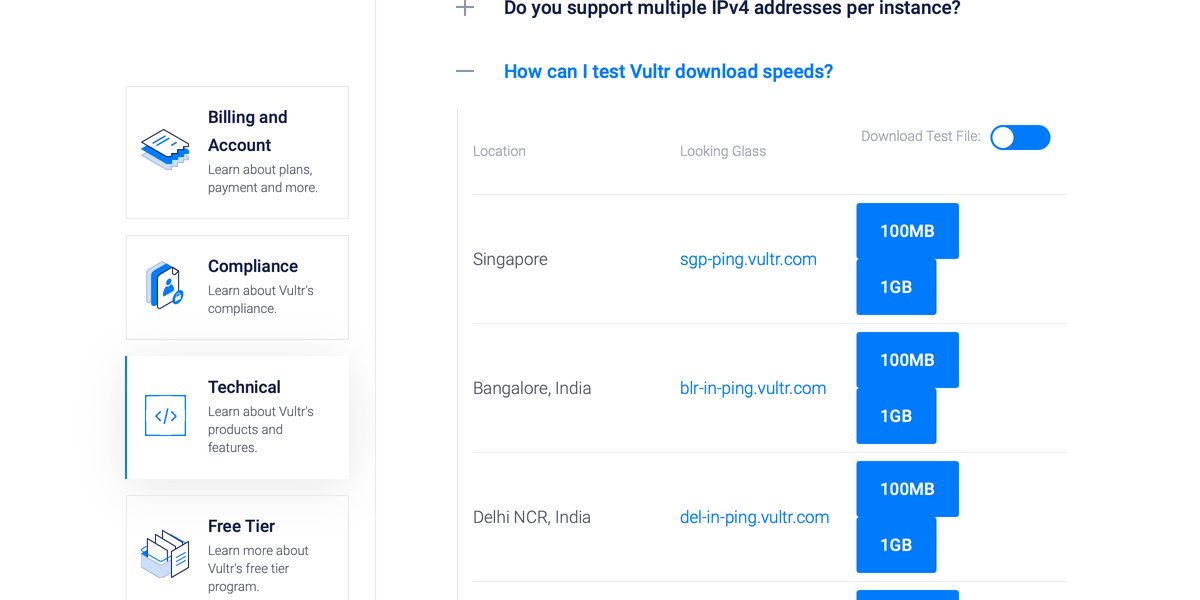
Well, if you don’t want to do it, there are URLs for every single server. These are the network looking glass’s URL. A looking glass page lets you check the network of each location directly from your browser.
When you click on the link, it will display the server details. You can also ping a website to test out the speed. It’s available for all Vultr server locations.
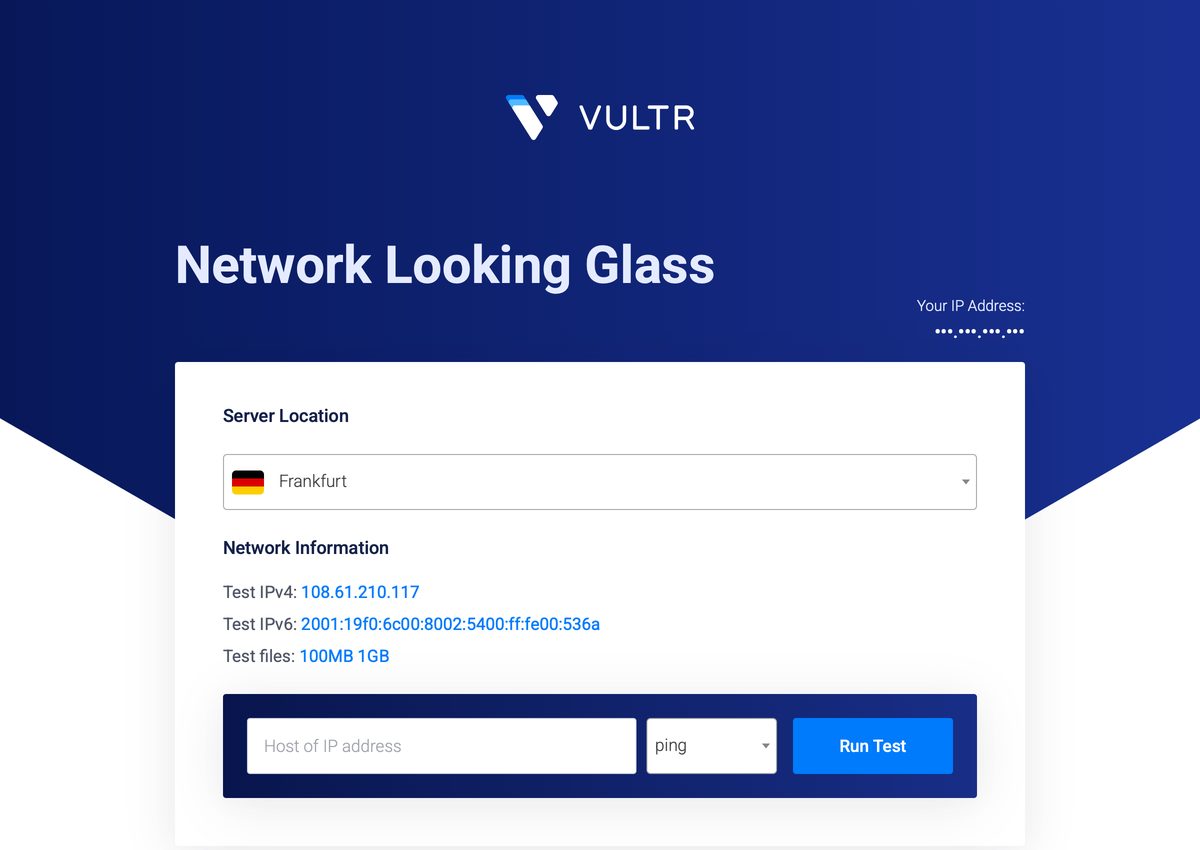
You will see the test IP of IPv4 and IPv6 as well as you will see the test files. You can enter your desired URL and ping it with the server.
If you are a technical person, you can try out this stuff to find the best server for you. Others can directly select the server with the download speed they get.
My round-trip test from New York
On November 18, 2026, I pinged Vultr's speed-test host in each region from my own Vultr server in New York (10 pings each, average). Vultr has no test host in Chennai, so 33 of the 34 regions are listed.
| Area | Round trip from my New York server (ms) |
|---|---|
| US and Canada | New Jersey 0.3, Chicago 18, Atlanta 21, Toronto 21, Miami 35, Dallas 38, Los Angeles 58, Seattle 59, Silicon Valley 64, Honolulu 107 |
| Latin America | Mexico City 61, São Paulo 126, Santiago 140 |
| Europe | London 70, Amsterdam 79, Manchester 82, Frankfurt 83, Paris 83, Stockholm 86, Madrid 87, Milan 93, Warsaw 103 |
| Middle East and Africa | Tel Aviv 132, Johannesburg 239 |
| Asia-Pacific | Tokyo 165, Osaka 165, Seoul 184, Sydney 201, Melbourne 201, Singapore 246, Bangalore 290, Mumbai 293, Delhi 311 |
Every request from a visitor waits at least one round trip, so a New York server answers visitors in Europe about 70 to 100 ms later than visitors on the US East Coast, and visitors in India about 290 to 310 ms later.
When I opened the create page that day, its location list showed 33 cities (Chennai wasn't in it), and only some had a green "Fully Available" mark for the plan I'd picked. Check that your plan is available in a region before you settle on it.
Server Status
You can also have a look at the server status page. Like all the server provider websites, Vultr also has a page where you can see the server status. You can head over to the server status page to see whether the particular server is available or not.
Sometimes, there might be some maintenance due to which the availability might get low. You can check all the things here. Even if the server might have future maintenance, you can check it here.
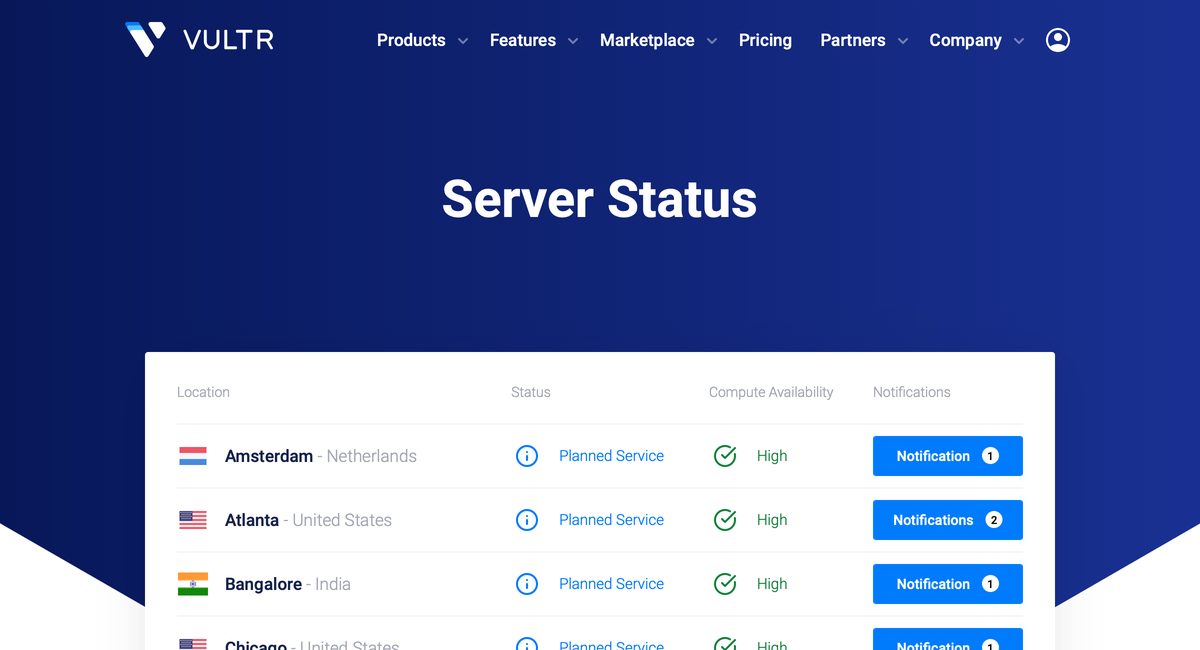
So, once you have a server with Vultr, it’s always good to have a quick link to this page. You might need it anytime.
Features of Server
If you are still here, you are probably looking for the features. Don’t worry, I have them covered too. We will now have a quick look at the features before we sum up the article.
Localized Peering
Vultr’s team is constantly working on their servers to make sure that there is the least latency and highest performance in all the servers. The main job of the team is to optimize the routing and peering agreement to make sure that they are working properly at high speed.
Location
Having 34 server locations is a great thing. They have 9 servers in the United States itself as they have a maximum number of users from the US.
You can easily select the “nearest” server location with this. By nearest, you won’t have to find the servers from another continent, you will easily find the nearest server.
Advanced Networking
They provide advanced networking for technical users. Things like DDoS mitigation, direct connect, reverse IP, etc are included here. You can have a look at the features page to know more about this.
Final Words
To conclude, this was all about Vultr data centers. They have 34 server locations across the globe. Out of 34, 9 of them are in the United States, and the rest are spread across Canada, Mexico, Brazil, Chile, the United Kingdom, the Netherlands, France, Germany, Spain, Italy, Sweden, Poland, Japan, South Korea, Singapore, India, Israel, Australia, and South Africa.
You can easily change the server location if you want. However, you will have to create a new instance. You can see all the details about the server.
They provide full transparency. You can ping the IP or host to know the speed of that particular server or you can even download a file to see what’s the download speed of the server.
So, if you are still thinking about whether you should go with Vultr or not, then the answer is yes. You can surely go with Vultr if it fits your needs.
We just saw Vultr server locations here. If all the other features and pricing match your criteria, you can surely go with them. They provide good speed and performance.
FAQ
What is the Vultr server?
Vultr is the Cloud infrastructure that provides various cloud services for your business needs. The server is where all your data is stored. Whenever someone opens your web app, the data loads from the server.
Is Vultr better than DigitalOcean?
Both of them are good in their own way. Depending on your requirements, you can choose your cloud service. Vultr offers affordable packages with high security and performance whereas DigitalOcean gives more storage and features.
How do I access the Vultr server?
You will get the direct OS screen from your account. You can surely install one of the panels to get started if you are not a technical person. A control panel such as cPanel or CyberPanel, both available as one-click apps in the Vultr Marketplace, would do the job here.
What is Vultr used for?
Vultr is a cloud service. You can use it to host and deploy your web applications, games, applications, and many more things.
What is Cloud VPS?
Cloud VPS is a private cloud server. The resources of a large cloud are split among many customers, and each one gets a fixed share. It’s like owning a part of the entire cloud with almost all the permissions.