

For containerized application hosting, you need to choose one of these cheapest Kubernetes hosting solutions.
If you are using cloud providers such as AWS, Azure, or even Google cloud, you could end up paying a lot more than you should. These providers charge you on an hourly basis as per your resource consumption.
Without even knowing, these resources could pile up pretty fast and end up giving you a huge monthly bill.
Instead, you can use these hosting providers.
 Vultr
Vultr Infomaniak
 IONOS
IONOSCompare these plans in a table
| Provider | Vultr | Infomaniak | IONOS |
|---|---|---|---|
| Best for | Low-cost clusters in many regions | Free traffic and CHF 300 trial credit | Custom nodes from $0.018 per vCPU per hour |
| Kubernetes type | Native managed Kubernetes | Native managed Kubernetes | Native managed Kubernetes |
| Control plane | Free | Free shared plan | Free |
| Nodes from | $10/month | CHF 4.70/month | Pay per use |
Contents
11 Cheapest Kubernetes Hosting
The first eight providers run native managed Kubernetes. They operate the control plane (the API server, etcd, and the scheduler) and handle version upgrades, while you pay for the worker nodes, storage, and load balancers your cluster uses. The last three are cloud servers where you install and run Kubernetes yourself, which costs less but leaves every upgrade and fix to you.
1. Vultr (Managed Kubernetes)
Vultr uses Vultr Kubernetes Engine ( VKE ) to host your Kubernetes. It has container orchestration to make the clusters work with each other. Their immutable infrastructure ensures that they won’t change the state.
Their VKE is Cloud Native Computing Foundation (CNCF), making it a reliable solution. Vultr has a free control plane (no management fees). For management, they have a cloud controller manager (known as CCM) that does the work for you by connecting all Vultr features to Kubernetes.
The service monitors the state and assigns the IP accordingly. Further, it automatically deploys a load balancer.
The pricing is attractive as you only pay for the working nodes and underlying resources. So, it’s totally up to you how many resources you want to add.
It integrates with apps such as help charts, cert-manager, Cluster autoscaler, and other similar apps.
Starting price: You can add resources as low as $10 a month.
Vultr data center locations
For North America, they have New Jersey, Chicago, Dallas, Miami, Honolulu, Seattle, Los Angeles, Atlanta, Silicon Valley (All of the previous are in the US), Mexico, and Toronto (Canada). They got Sau Paulo (Brazil) in South America. European locations include Amsterdam (Netherlands), Stockholm (Sweden), London (UK), Frankfurt (Germany), Paris (France), Warsaw (Poland), and Madrid (Spain).
In Asia, Vultr has Tokyo (Japan), Seoul (S. Korea), Singapore, Mumbai (India), Delhi NCR (India), and Bangalore (India). Sydney and Melbourne are available in Australia. Finally, you can choose Johannesburg in Africa.
2. Infomaniak (Managed Kubernetes)
Infomaniak is a Swiss provider that runs managed Kubernetes on its own Public Cloud. It handles the Kubernetes components and updates, and you can upgrade the control plane and worker nodes at any time. You can choose from the three latest stable Kubernetes versions, and clusters use Cilium for networking by default.
The control plane comes in two forms:
- Shared (free): one API server replica, up to 10 nodes, no SLA.
- Dedicated: from CHF 0.04 per hour (about CHF 29 a month), with dedicated control plane resources, three etcd replicas, up to 50 nodes, and a 99.9% SLA.
Worker nodes are billed at normal Public Cloud rates, and this is where Infomaniak gets cheap:
- Node with 1 vCPU, 2 GB of RAM and 20 GB of storage: CHF 0.0064 per hour, roughly CHF 4.70 a month if it runs all month (730 hours).
- Traffic: incoming and outgoing traffic is free.
- Load balancer: CHF 0.0137 per hour (about CHF 10 a month).
New customers get CHF 300 in credit to use within 3 months. A bank card is required, and Infomaniak places a CHF 20 hold on it during signup. Prices are in Swiss francs, so the cost in dollars or euros moves with the exchange rate.
Starting price: Free Shared control plane. Worker nodes from about CHF 4.70 a month each.
Infomaniak data center locations
Infomaniak runs its own data centers in Switzerland, and all Kubernetes clusters are hosted there. You choose the region for the control plane and the availability zone for each node pool. That makes it a good fit for European projects that need data to stay under Swiss jurisdiction, but users in the US or Asia will see higher latency.
3. IONOS (Managed Kubernetes)
IONOS offers Managed Kubernetes on its IONOS CLOUD platform. IONOS doesn't charge for the cluster or its geo-redundant control plane.
Your bill covers the worker nodes, storage, and traffic. The service is CNCF certified.
Instead of choosing from fixed node sizes, you build each node pool yourself. You pick the CPU type, the number of cores, RAM, storage size, and storage type for every node. IONOS installs updates and security fixes automatically, and you choose the maintenance window when they run.
There are two CPU options:
| CPU type | Per vCPU or core, per hour | Per GB of RAM, per hour |
|---|---|---|
| vCPU | $0.018 | $0.0027 |
| Dedicated core | $0.05 | $0.0071 |
A single vCPU node with 2 vCPUs and 4 GB of RAM works out to about $34 a month (730 hours). Block storage (from $0.0533 per GB per month for HDD) and outgoing traffic (from $0.09 per GB) come on top.
That makes IONOS more expensive than DigitalOcean or Vultr for a tiny cluster, but the dedicated cores are good value for heavier workloads.
You can set a minimum and maximum node count for autoscaling, and a CSI storage driver lets pods create persistent volumes automatically. If you commit for 1 or 3 years, Cloud Savings Plans lower the dedicated core and RAM prices. New accounts get $200 in free credit for 30 days, but you need to add payment details to activate it.
Starting price: Free control plane. Nodes billed per vCPU, GB of RAM, and storage.
IONOS data center locations
IONOS CLOUD has data centers in Las Vegas, Newark, and Lenexa in the US. In Europe, you can choose Frankfurt or Berlin (Germany), Paris (France), London or Worcester (UK), and Logroño (Spain). There are no locations in Asia or Australia.
4. DigitalOcean (Managed Kubernetes)
DigitalOcean Kubernetes (DOKS) is the easiest managed option on this list for small teams. You create a cluster from the control panel, the API, or the doctl command line tool, and DigitalOcean runs the control plane for you, including etcd, the API server, the scheduler, and the cloud controller manager.
What you pay for:
- Control plane: free. If you need it to stay up during a failure, the high-availability option costs $40 per month.
- Worker nodes: regular Droplets. The cheapest has 1 vCPU and 2 GB of RAM for $12 per month, and each node adds outbound transfer starting at 2,000 GiB per month.
- Extras: load balancers ($12 per month each) and any block storage volumes you add.
DigitalOcean recommends at least two nodes so your apps keep running while one node is upgraded, so a realistic small cluster starts around $24 per month.
Autoscaling is included, and you can add GPU node pools later if your workload needs them.
Starting price: Free control plane. Worker nodes from $12 a month each.
DigitalOcean data center locations
DOKS is available in every DigitalOcean data center. In North America, you can choose New York, San Francisco, Atlanta, Richmond, Kansas City, Memphis (US), and Toronto (Canada).
In Europe, you can pick Amsterdam (Netherlands), London (UK), or Frankfurt (Germany). In Asia-Pacific, the options are Singapore, Bangalore (India), and Sydney (Australia).
5. Akamai / Linode (Managed Kubernetes)
Linode is now part of Akamai, and its managed Kubernetes service is sold as the Linode Kubernetes Engine (LKE) on Akamai Cloud. The platform is CNCF certified, so standard Kubernetes tools like Helm charts, controllers, and operators work as expected.
What you pay for:
- Control plane: free. A high-availability control plane costs $60 per cluster per month.
- LKE Enterprise: a flat $300 per cluster per month for larger production setups, with a dedicated HA control plane, premium NodeBalancers, and VPC isolation.
- Worker nodes: regular Linode plans. The 1 GB Nanode can't be used in LKE node pools, so the cheapest node is the 2 GB shared CPU plan (1 vCPU, 50 GB of storage, 2 TB of transfer) for $12 per month.
- NodeBalancer: $10 per month, which you'll need for a public load balancer.
- Traffic: ingress is free, and egress beyond the included transfer costs $0.005 per GB.
Eligible new accounts can get $100 in free credit, which is enough to try a small cluster before you pay anything.
Starting price: Free control plane. Worker nodes from $12 a month each.
Akamai / Linode data center locations
LKE runs in all 33 of Akamai's core compute regions. In North America, that includes Newark, Washington DC, Atlanta, Miami, Chicago, Dallas, Fremont, Los Angeles, Seattle (US), and Toronto (Canada). São Paulo (Brazil) covers South America.
In Europe, you can choose London, Frankfurt, Amsterdam, Paris, Madrid, Milan, and Stockholm. Asia-Pacific options include Mumbai, Chennai, Singapore, Jakarta, Tokyo, Osaka, Sydney, and Melbourne.
6. UpCloud (Managed Kubernetes)
UpCloud is a Finnish cloud provider, and its UpCloud Kubernetes Service (UKS) runs the control plane for you: setup, monitoring, health checks, and cluster upgrades. The service is part of the CNCF conformance program, so standard tools like kubectl, Helm, and Terraform work without changes.
What you pay for:
- Control plane: the Development plan is free, with a single control plane host and up to 30 nodes. The Production plan costs $60 per month and adds a high-availability control plane for up to 120 nodes.
- Worker nodes: regular Cloud Servers from the Starter, Premium, or Cloud Native plans, with at least 2 GB of RAM. The cheapest option is the Starter plan with 1 core, 2 GB of RAM, and 20 GB of storage for $7 per month.
- Load balancer: the built-in Managed Load Balancer has a free Essentials tier, and the Development tier costs $10 per month.
- Traffic: UpCloud charges no egress fees, under a fair transfer policy.
Starter plans are billed by the hour, and a month is capped at 28 days of charges. UpCloud also advertises a 30-day free trial with $500 in credit, which is enough to test a small cluster.
Starting price: Free Development control plane. Worker nodes from $7 a month each.
UpCloud data center locations
UKS is available in all 15 UpCloud locations. In Europe, you can choose Helsinki (two zones), Stockholm, Copenhagen, Stavanger, London, Amsterdam, Frankfurt, Warsaw, and Madrid.
North America has New York, Chicago, and San Jose (US). In Asia-Pacific, the options are Singapore and Sydney (Australia).
7. OVHcloud (Managed Kubernetes)
OVHCloud is yet another certified cloud platform offering managed clusters for Kubernetes. They manage all the Kubernetes components for you including Docker runtime. It supports pod autoscaling to grow your cloud as you go.
One of the best things about OVHCloud is the choice of various versions you can install. They offer multiple (even minor) versions of Kubernetes.
You can choose from the last 3 versions. This gives you enough time to update your code to the latest version.
You can add persistent volumes to the working nodes.
If you have developers working on your web app, you can add role-based control. It’s not recommended for beginners as the support is slow to respond. It’s one of the cheapest Kubernetes hosting providers because the managed Kubernetes service is provided without any cost.
You just need to pay for the compute instance.
Starting price: No cost for managed Kubernetes. Compute starts at $29 a month
OVHCloud data center locations
For the Americas, they have a Canadian data center. They also had a data center in the US. However, US data centers are not available for computing and block storage.
Europe has many options. You can choose Warsaw (Poland), Frankfurt (Germany), and they have 3 locations in France including Gravelines, Roubaix, and Strasbourg.
Apart from Europe and America, they have an Asian data center in Singapore and one in Australia.
8. Oracle Cloud (Managed Kubernetes)
Oracle Cloud Infrastructure runs managed Kubernetes through OCI Kubernetes Engine (OKE). It's one of the few ways to run a small managed cluster for close to nothing, because both the basic control plane and some Arm compute are free.
OKE has two cluster types:
- Basic cluster: free control plane, covering core Kubernetes features with managed node pools.
- Enhanced cluster: $0.10 per cluster per hour (about $73 a month), adding virtual nodes, add-on management, workload identity, and a financially backed SLA. Virtual nodes cost an extra $0.015 per node per hour.
The free part comes from Oracle's Always Free tier:
- All tenancies get 1,500 OCPU hours and 9,000 GB hours per month on Ampere A1 Arm instances, which equals 2 OCPUs and 12 GB of RAM running all month.
- Oracle cut this allowance in half in June 2026, so older guides that mention 4 OCPUs and 24 GB are out of date.
- Your container images need to support Arm (arm64) to run on these nodes.
Beyond the free tier, Ampere A1 capacity costs $0.01 per OCPU per hour and $0.0015 per GB of RAM per hour. New accounts also get $300 in credit to use within 30 days. Oracle's console has more settings than the smaller providers, so expect a steeper learning curve.
Starting price: Free basic control plane. Always Free Arm capacity for small nodes.
Oracle Cloud data center locations
OKE is available in Oracle's public cloud regions, which cover North America, South America, Europe, the Middle East, Africa, and Asia-Pacific. Free tier accounts are limited to one home region, which you choose at signup and can't change later.
Self-Managed and Kubernetes-Ready Hosts
These three providers don't run the control plane for you. You get cloud servers or VPS instances and set up Kubernetes (or a lighter distribution like K3s or MicroK8s) yourself. The server price is often lower than a managed cluster, but you're responsible for installing, upgrading, securing, and backing up the cluster.
9. Kamatera (Kubernetes-Ready Cloud)
Kamatera doesn't sell managed Kubernetes clusters. Instead, it gives you Kubernetes-ready cloud servers: when you create a server from its Kubernetes page, you can deploy a MicroK8s image (versions 1.32 to 1.35 on Ubuntu Server 24.04) instead of installing everything by hand.
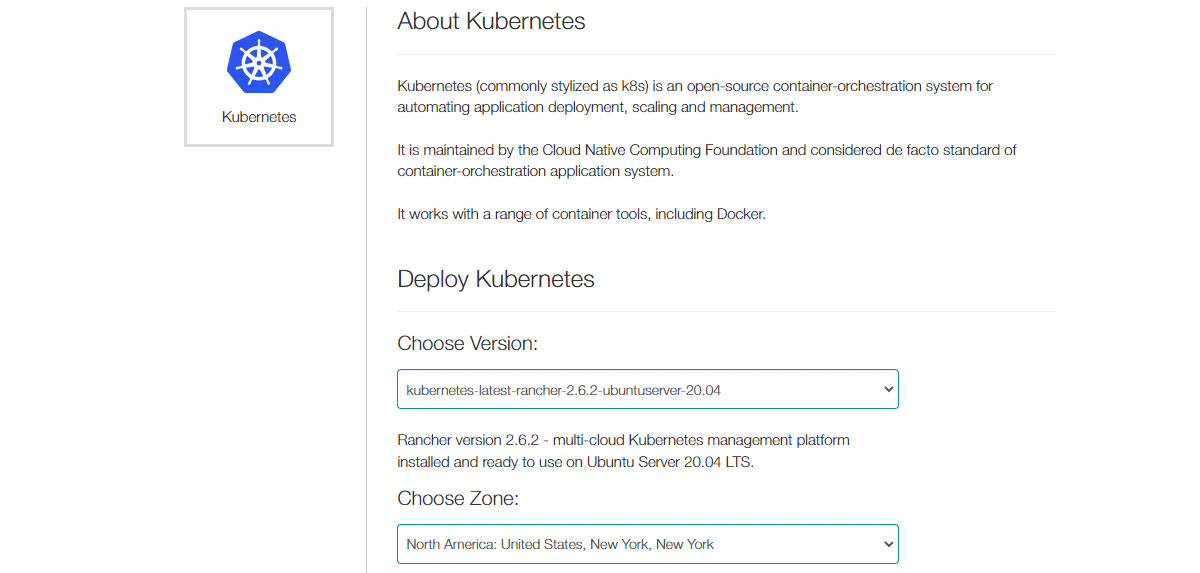
Each server is fully configurable. You pick the CPU type, from shared "Availability" vCPUs to dedicated cores, then the number of vCPUs, RAM, and storage.
Kamatera recommends at least 2 cores and 4 GB of RAM per node. You build a multi-node cluster by creating more servers and joining them, and you can add or remove worker nodes as your load changes.
Kamatera also sells a managed service add-on, but it covers the server's operating system and system configuration, not the Kubernetes cluster. Upgrades and troubleshooting inside the cluster are still your job, so this option suits people who already know Kubernetes.
The 30-day free trial lets you run one server with a configuration worth up to $100 and 1,000 GB of traffic. A credit card is required, but it isn't charged if you stay within those limits.
Starting price: The default configuration in Kamatera's Kubernetes price calculator is $12 a month. Extra traffic costs $0.01 per GB.
Kamatera data center locations
Kamatera offers 21 locations. In North America, you can choose New York, Atlanta, Miami, Chicago, Dallas, Santa Clara, Los Angeles, Seattle (US), and Toronto (Canada). In Europe, the options are Amsterdam (Netherlands), Frankfurt (Germany), London (UK), Madrid (Spain), Milan (Italy), Stockholm (Sweden), and Bucharest (Romania).
In Asia-Pacific, you can choose Hong Kong, Tokyo (Japan), Singapore, and Sydney (Australia). Tel Aviv (Israel) is also available.
10. Hetzner (Self-Managed)
Hetzner is a self-managed hosting service offering amazing performance. The price is also reasonable. It requires technical knowledge.
You can use K3S for Kubernetes hosting. Just like Contabo, you will need technical knowledge if you want to get the best out of it.
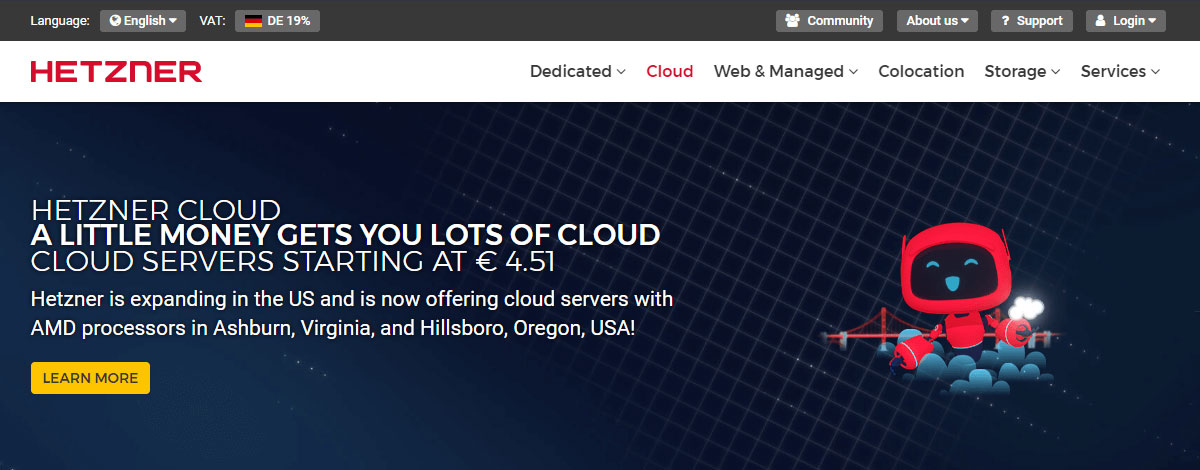
You can still use the automation with powerful API. Further, it has a load balancer. So, it can be an excellent host for your Kubernetes hosting.
The hosting is reliable as it comes with a 10 Gbit network connection. It supports primary IPs and floating IPs. The online community is reliable.
So, you can easily get help from the community. They also have a complete tutorial on how to get Kubernetes set up.
The hosting service is good. However, it requires identity verification. So, if you don’t want to provide ID proof, you might want to consider a different one.
Hetzner raised its cloud prices in June 2026, and its shared cloud plans currently show as unavailable to order, so check availability before you plan a cluster around it.
Starting price: €5.99 per month for the CPX02 cloud server (1 shared vCPU, 1 GB RAM, 20 GB NVMe) in Germany and Finland.
Hetzner data center locations
In the USA, Hetzner has cloud locations in Ashburn (Virginia) and Hillsboro (Oregon). In Europe, you can use Falkenstein or Nuremberg (Germany) and Helsinki (Finland), and Singapore covers Asia.
11. Contabo (Self-Managed)
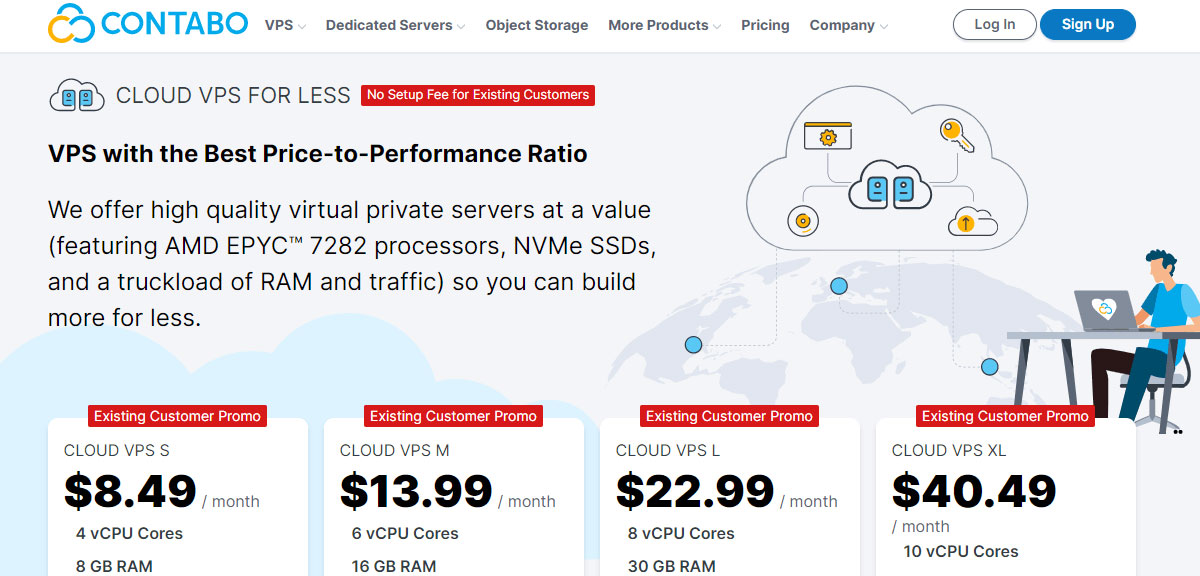
Cheap priced VPS usually has low specs. However, that’s not the case with Contabo. It’s a self-managed cheapest Kubernetes hosting with high specs.
They have unmetered bandwidth in and 32 TB out. If you don’t want to worry about the updates and security, you can add their managed option.
Please note that it’s for managed servers and not for managed Kubernetes clusters.
The management isn’t that difficult as they have cloud-init and CLI to manage the server. It’s not recommended if you are not a technical person as the support is also slower. It might take longer than expected to solve your query.
However, if you have the required knowledge and want to host heavy-load apps, Contabo’s German-quality hardware is a reliable option.
Starting price: $8.49 per month (setup fee of up to $8.49 for 1, 3, and 6 months plans). An extra fee of up to $3.90/month is charged if you want other data centers except for Germany.
Contabo data center locations
The free data center is available only in Germany which is in Europe. Apart from this, they data center in the UK. However, there is an extra charge for it.
They have 3 data centers in North America (US east, west, and central). For Asia and Australia, you can choose Singapore or Sydney respectively.
Buying guide for Kubernetes clusters (5 Tips)
Management
Kubernetes administration includes backups, patching, and updating it. It makes your work a lot easier if you have managed platform for Kubernetes.
It makes your management super-easier. This alone will save you a ton of your time.
Monitoring and Operations Management
The main production cluster of Kubernetes must be monitored to catch and resolve all the issues before the time.
High availability
Having a highly available etcd cluster is important. Along with that, you also need to ensure that you have available nodes on multiple data centers. In case, one data center node stops working, the self-healing feature does the work for you.
Ease of Setup, Installation, and Maintenance
The Kubernetes setup and installation can be tough. A managed Kubernetes hosting will help you with that. If it’s not managed hosting, you should see if setup and maintenance are easy to do.
Cluster Upgrades
A new version of the Kubernetes cluster is available after every 3 months. The server should offer the upgrades. More importantly, the cluster and cluster API should be usable when it’s upgrading.
The ability to roll back to a previous version is yet another advantage.
Load Balancing
A load balancer helps you when there are traffic spikes. So, make sure that your cheap Kubernetes hosting includes a load balancer.
Conclusion
Installing and playing around the dev environment is all fun and games. However, in a production environment, you require a lot more management and administration.
So, you can use a managed solution that provides a load balancer and has incredible support.