

For most people, no. GoDaddy now adds Domain Privacy free to every eligible domain it registers, so your contact details are already hidden from the public WHOIS record. What you can still pay for is Domain Protection (Full or Ultimate), which adds alerts, identity checks before transfers, and, with Ultimate, an extra 90 days to renew if a failed payment lets your domain expire.
In client accounts I manage at GoDaddy, Full Domain Protection costs $12.99 for the first year and $14.99 a year after that, and Ultimate costs $21.99, then $32.99 a year. Below I explain what each layer does, what it costs, and when the paid protection is worth it.
Prices and plan details on this page were checked in November 2026.
Contents
What is GoDaddy full domain privacy and protection?
The Internet Corporation for Assigned Names and Numbers ( ICANN ) regulates domain name registrations. It keeps a public, global record of domain ownership in the WHOIS database.
All domain registrars must collect domain owners' details for the WHOIS record. Your name, email, address, and phone number can be displayed publicly to track domain ownership.
That leads to spam emails and calls. To prevent this, domain privacy services were introduced: a company lists its details on your behalf, and messages are forwarded to you. At GoDaddy, that company is Domains By Proxy, and you choose between three privacy levels:
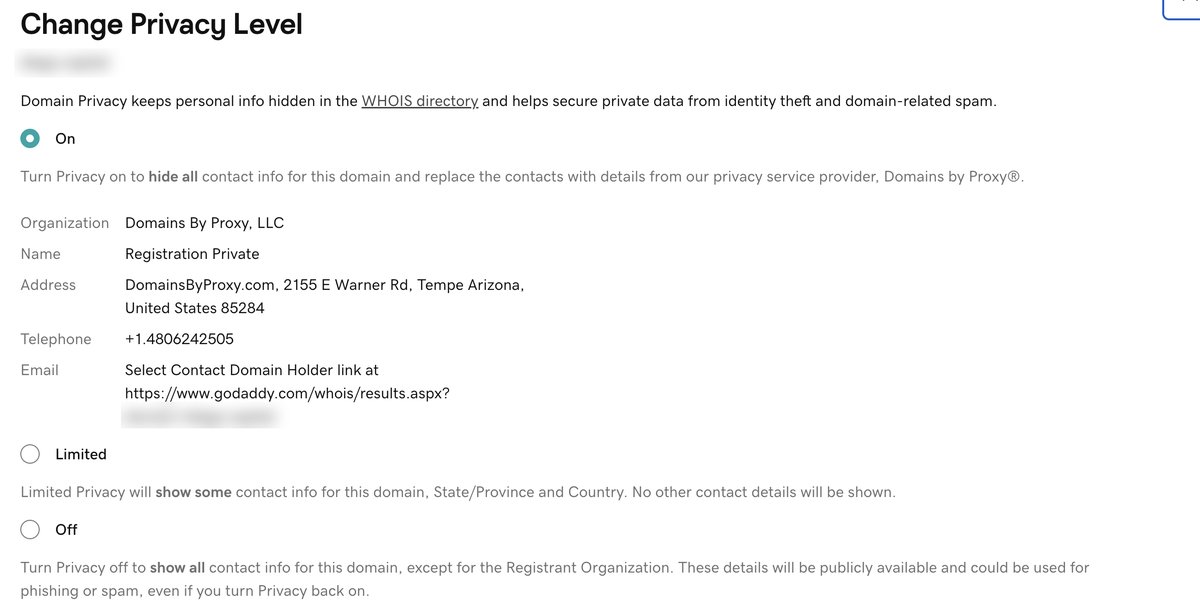
The privacy settings of a domain in a client's account I manage: On, Limited (state and country only) or Off (November 20, 2026).
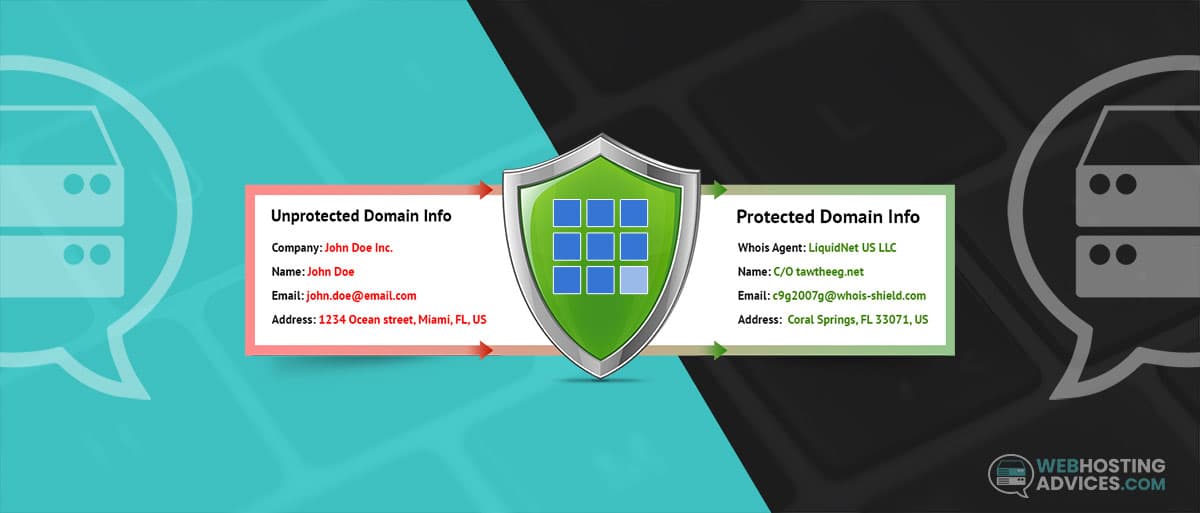
With privacy On, the WHOIS record shows Domains By Proxy, LLC and an address in Tempe, Arizona instead of your details. Limited shows only your state or province and country, and Off shows everything except the registrant organization. Basic privacy is free.
Since ICANN requires someone to take responsibility for the domain, the privacy service is listed as the contact, while you stay the owner in GoDaddy's records.
Domain privacy and protection services do three main jobs:
Hides your details
Domain privacy keeps your contact info out of the public WHOIS record.
Your name won't show in the WHOIS database, since your registrar replaces it with the proxy's details. So you can run a website without publishing your home address.
Protects against domain thefts
Public contact details make domain theft easier. Hackers who know the email you used to register a domain can target that email or your registrar account.
Some registrars add two-factor authentication or other security steps to protect your domain. GoDaddy's paid Domain Protection adds an identity check before transfers and other high-risk changes, and locks the domain against unauthorized transfers.
Blocks and prevents spam
One of the biggest advantages of a domain privacy service is less spam. Website owners who have been around for years know the pain of junk emails.
Privacy services keep your email address out of public WHOIS records, so spammers who harvest addresses from those records can't find it.
Keeping your address out of WHOIS also cuts down on phishing emails that pretend to come from your registrar or host. It won't stop every attack, so keep two-step verification turned on for your GoDaddy account.
In Europe, many registrars hide your details by default because of stronger data protection rules. The General Data Protection Regulation ( GDPR ) led to redacted WHOIS information, where your details show as "redacted for privacy".
Basic vs. Full vs. Ultimate privacy protection
GoDaddy has changed its lineup. Domain Privacy is now added automatically, at no cost, to every eligible domain registered with GoDaddy. The paid add-ons only cover domain protection:
- Full Domain Protection
- Ultimate Domain Protection
- Domain Ownership Protection (only for some extensions)
The current plans split privacy and protection. Domain Privacy replaces your contact details in the WHOIS directory with those of Domains By Proxy, while the protection plans stop someone from taking over your domain or letting it expire by mistake:
| Feature | Domain Privacy (free) | Full Domain Protection | Ultimate Domain Protection | Domain Ownership Protection |
|---|---|---|---|---|
| Hides your contact details in WHOIS, through GoDaddy's proxy service | ✓ | ✓ | ✓ | ✓ |
| Alerts and a one-time code or 2-step check before transfers, DNS edits, and privacy changes | No | ✓ | ✓ | ✓ |
| Blocks unwanted transfers and other unauthorized actions | No | ✓ | ✓ | ✓ |
| Activity log of domain changes | No | ✓ | ✓ | ✓ |
| A 90-day grace period if a failed payment lets the domain expire | No | No | ✓ | ✓ |
| No redemption fee after an accidental expiration | No | No | ✓ | ✓ |
| Available for | All eligible domains | Most extensions | Most extensions | Specific extensions only |
Source: GoDaddy's help article What is Domain Protection?, checked October 17, 2026. Some extensions can't use every protection feature, and auto-renew is switched on for protected domains.
The legacy Ultimate plan also scanned your website for malware and monitored search engines. The current protection plans focus on the domain itself.
How much does GoDaddy privacy protection cost?
GoDaddy doesn't list the prices of its current protection plans on its help pages, so I checked them in the domain portfolio of client accounts I manage at GoDaddy:
| Plan | First year | Renewal | What it adds |
|---|---|---|---|
| Full Domain Protection | $12.99 | $14.99/year | Identity check before high-risk changes, an alert before a transfer out, verified contact changes, and protection against scammers sending email as your domain |
| Ultimate Domain Protection | $21.99 | $32.99/year | Everything in Full, plus 90 extra days to renew if the domain expires after a failed payment |
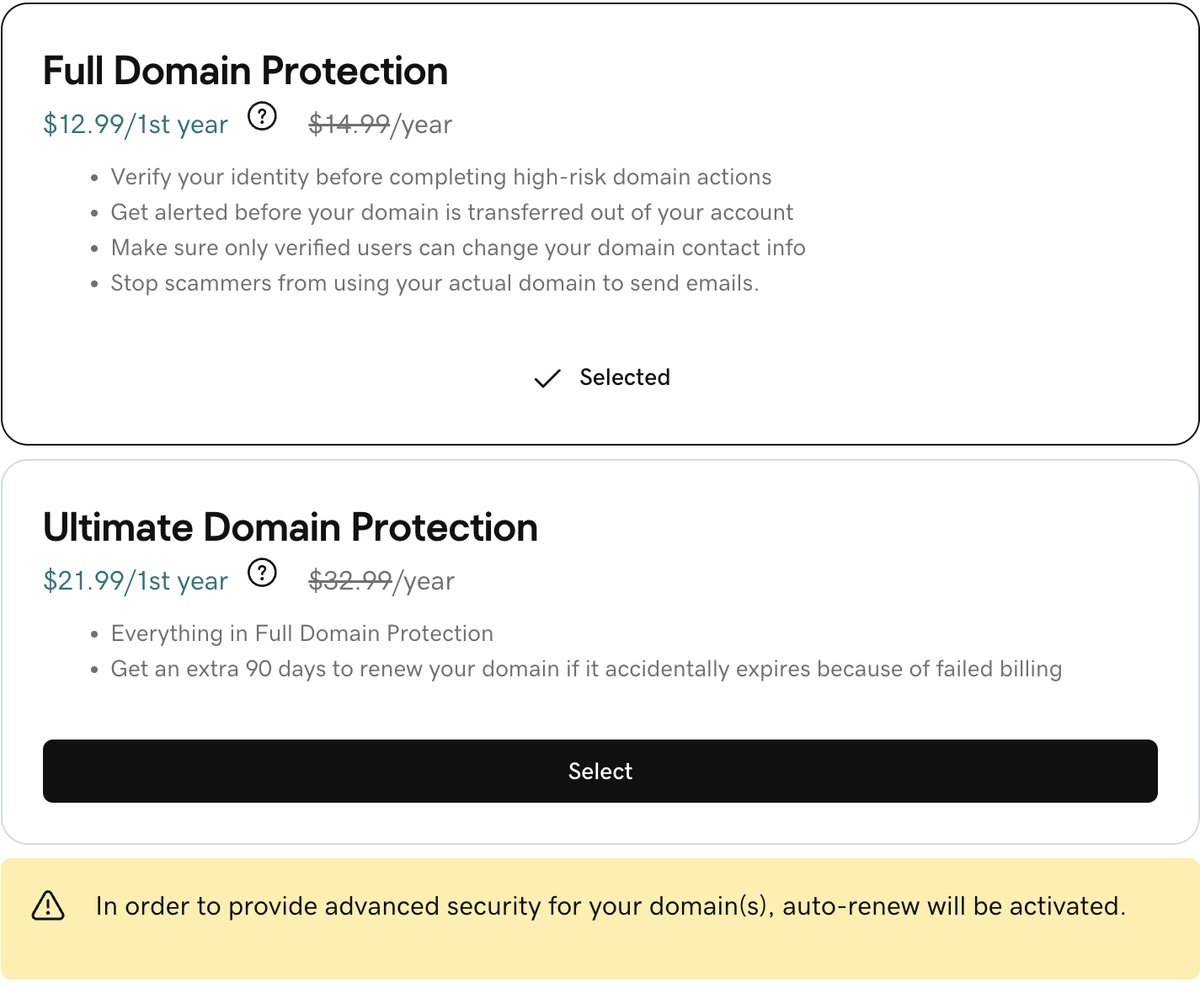
The protection plans offered on a client's domain (GoDaddy domain portfolio, November 20, 2026).
Choosing either plan switches auto-renew on, as the yellow warning says. Downgrading from Ultimate to Full shows the opposite warning: you lose the extra 90 days of protection against a failed renewal.
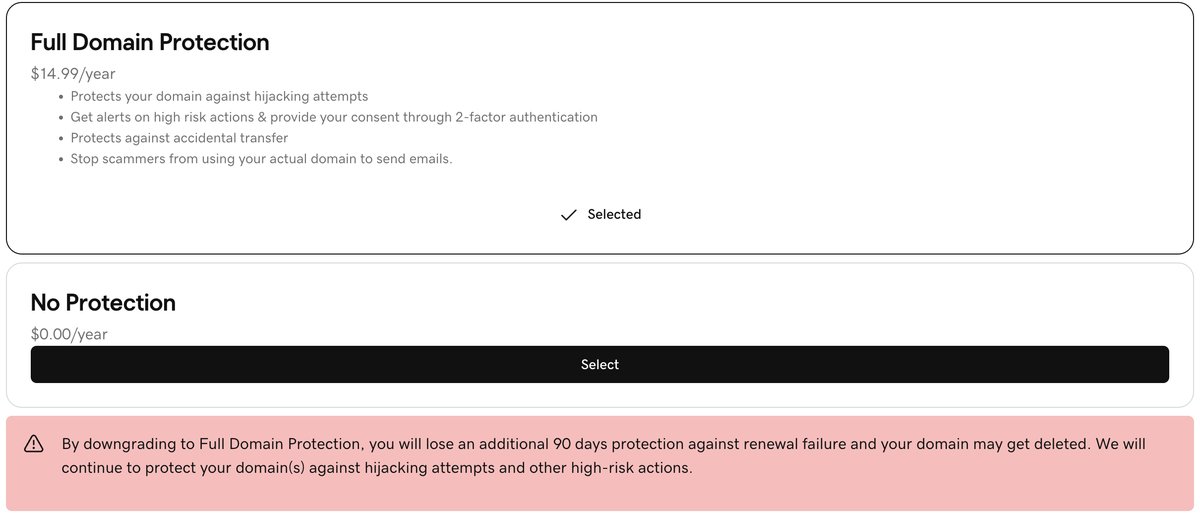
The downgrade warning on a client's domain with Ultimate protection (November 20, 2026).
Domains that still have a legacy plan keep its old yearly price, billed for the same term as the domain: Full Domain Privacy & Protection was $9.99 a year and Ultimate Domain Protection & Security $29.99 a year.
Registrars with free domain privacy
Since GoDaddy's basic privacy is free, the real question is what you pay each year for the domain and any protection. Some registrars include privacy free and renew for less:
Namecheap
I'm a Namecheap customer myself: I register my own domains there, including webhostingadvices.com, plus several domains for client sites.
Namecheap's free privacy service is Withheld for Privacy. It's free for life with every eligible new registration or transfer and turned on by default (Namecheap's domain privacy page). It replaces your email with a unique forwarding address that filters spam, and you can rotate that address.
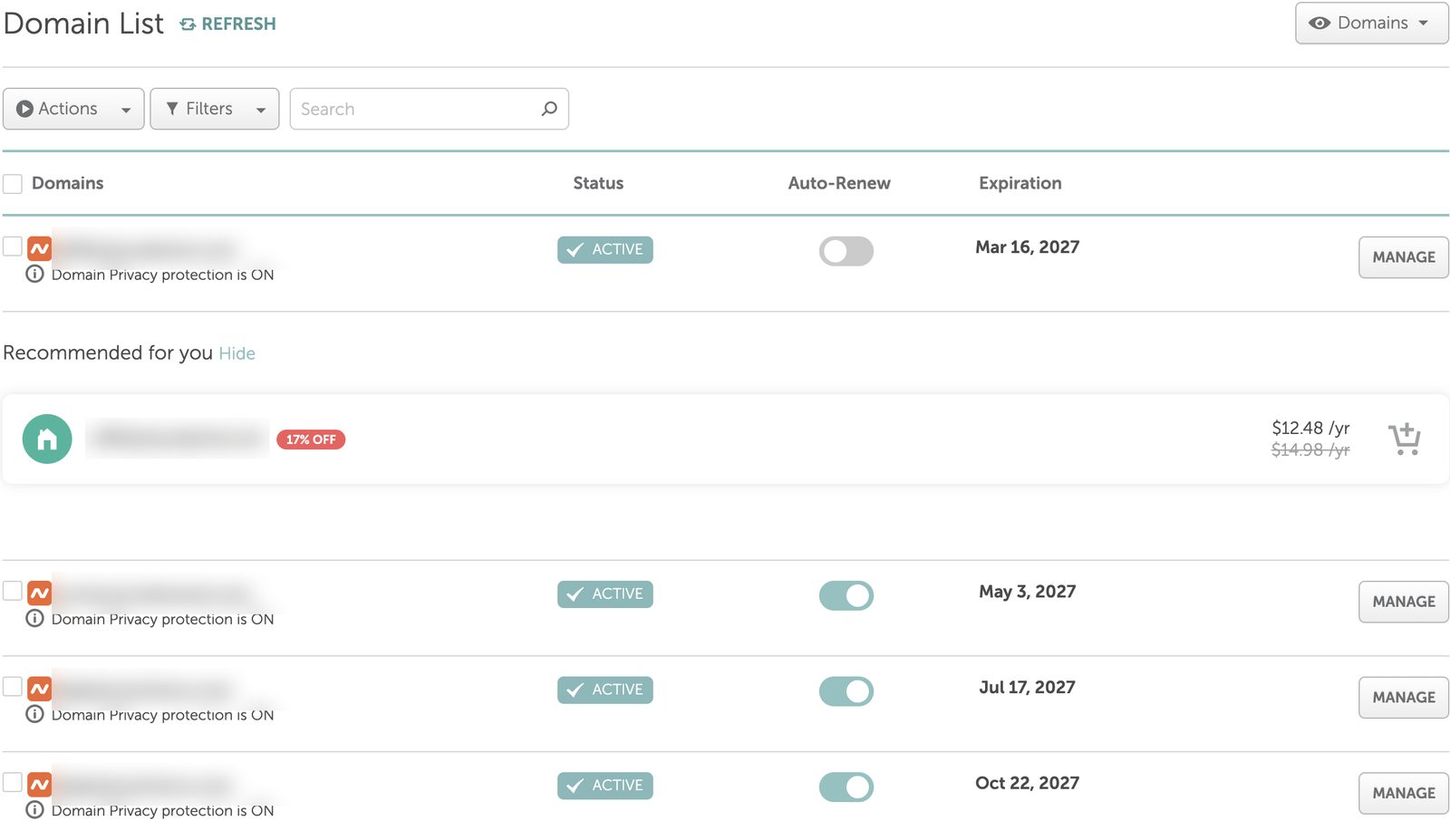
My own Namecheap domain list: privacy is on for every domain (November 13, 2026).
In my account, privacy runs with its own auto-renew toggle next to the domain's, and it costs nothing. One limit: due to registry rules, Withheld for Privacy can't be used on some extensions, such as .us, .uk, .ca, .de, .eu, .in and .com.au.
NameSilo
Like Namecheap, NameSilo includes free WHOIS privacy for life. A .com costs $19.99 a year and renews at the same price, which is less than GoDaddy's $22.99 renewal.
NameSilo also lets domain owners customize their WHOIS records, which can be useful for domain resellers.
Pros & Cons of GoDaddy privacy domain protection
Privacy is free at GoDaddy, so the pros and cons below are about the paid Full and Ultimate protection plans.
Pros of GoDaddy domain protection
- Identity check before high-risk changes: transfers, DNS edits and privacy changes need a one-time code or your 2-step verification.
- An alert before a transfer out, so a hijack attempt doesn't go unnoticed.
- Verified contact changes, which makes it harder to take over the domain by changing the registrant email.
- Protection against scammers using your domain to send email, as listed on the Full plan.
- With Ultimate, 90 extra days to renew if the domain expires after a failed payment, without a redemption fee.
Cons of GoDaddy domain protection
- An extra yearly expense on top of your domain renewal: $14.99 (Full) or $32.99 (Ultimate) a year after the first year.
- Choosing a plan switches auto-renew on, so check that setting if you planned to let the domain lapse.
- To transfer the domain away, you have to downgrade the protection to none first, as GoDaddy's transfer steps require (GoDaddy help).
- It doesn't add any privacy you don't already get free. Two-step verification and auto-renew already cover part of the risk at no cost.
Is GoDaddy domain privacy and protection worth it?
No, GoDaddy's paid domain protection is not worth it in most cases. GoDaddy now includes Domain Privacy for free, so the paid plans only add protection against unwanted transfers and accidental expiration.
Instead of an extra expense, I recommend a registrar that includes privacy free and renews for less, like Namecheap, which I use for my own domains, or NameSilo.
Two-step verification on your GoDaddy account and auto-renew already cover part of that risk. Buy a protection plan if you want to stay with GoDaddy and want an extra approval step before anyone can transfer or change your domain.
When to buy it?
- Your domain runs a business where a hijack or an unauthorized transfer would be costly.
- You want a code check before anyone can transfer the domain, change its DNS or edit its contacts.
- You want an alert before the domain is transferred out.
- Your payment card might fail or expire unnoticed, and you want Ultimate's 90 extra days to renew.